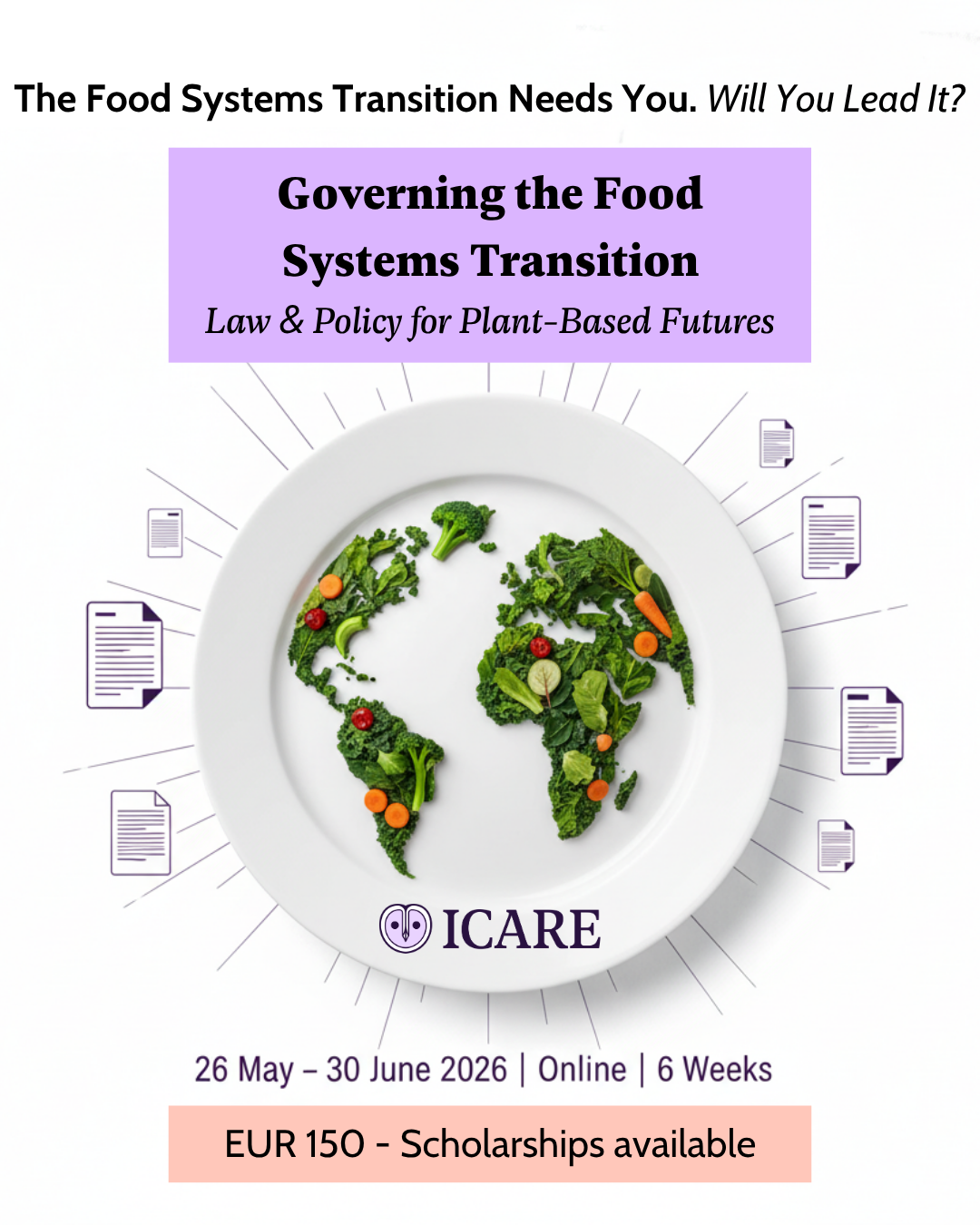
Governing the Food Systems Transition: Law & Policy for Plant-Based Futures

Online short course & policy clinic
26 May - 30 June 2026
A six-week online course for lawyers, policymakers, advocates, researchers, and practitioners working to shape food systems change.
Food systems are at the centre of some of the most urgent challenges of our time: animal welfare, climate change, biodiversity loss, public health, antimicrobial resistance, food security, and justice. Yet many of the people working on these issues have had little opportunity to think through, in a structured and practical way, how food is governed in their own legal system, which institutions hold power, and which legal and policy tools are actually available to support a transition towards plant-based and alternative protein futures.
This course is designed to help fill that gap.
Through a combination of expert-led teaching and a practice-oriented policy clinic, participants will develop a strong grounding in the legal and policy dimensions of food systems transition and build a concrete, context-specific roadmap for their own jurisdiction.
Course Structure
The course runs online over six consecutive weeks.
Each week includes 2 to 3 hours of live teaching delivered by an international faculty of legal scholars, policy experts, and practitioners working directly on food systems, strategic litigation, food labelling, plant-based policies, and the regulation of alternative proteins.
Alongside the live sessions, participants complete short, focused written assignments that build progressively from week to week. These tasks form the core of the course’s policy clinic component.
Rather than remaining at the level of general discussion, participants will work systematically on their own jurisdiction throughout the course. They will receive written feedback on their assignments, helping them refine their analysis and develop work that can remain useful after the course, whether for internal memos, advocacy strategies, consultation responses, policy development, or future legal and policy interventions.
By the end of the course, each participant will have developed a concrete policy roadmap for their own jurisdiction.
About the GFST Course
-
Duration
6 weeks
-
Dates
26 May to 30 June 2026
-
Live teaching
Tuesdays, 4:00 pm CEST (Paris time)
-
Format
Online
-
Fee
150 EUR, with scholarships available
-
Certificate
To earn the certificate of completion, participants must attend 75% of the live lectures and complete the final roadmap assignment for the policy clinic.
Why take this course?
Food systems are not governed by a single body of law or a single ministry. They are shaped by a complex web of legal rules, institutions, standards, trade frameworks, funding choices, and policy decisions. For anyone trying to advance plant-based or alternative protein policies, this complexity can make it difficult to know where to begin.
This course offers a clear and legally grounded way into that landscape.
It is designed for people who want to move beyond broad calls for food systems change and develop a more precise understanding of how change happens in practice: which institutions make decisions, which legal instruments they use, what constraints international and regional frameworks create, where policy opportunities exist, and how advocates can identify realistic entry points in their own jurisdiction.
The course has an international scope and considers contexts outside the usual Global North examples. It encourages participants to engage critically with questions of justice, equity, culture, livelihoods, and political feasibility, while remaining ambitious about transforming food systems to better serve animals, people, and the planet.


Who is this course for?
This course is intended for people who are already working on, or preparing to work on, food systems change in law, policy, government, or civil society.
It is particularly suited to:
legal professionals working in practice, academia, NGOs, or public institutions who want to engage more systematically with food systems, plant-based policies, and alternative proteins;
policy officers and public officials working in areas such as agriculture, health, environment, trade, education, public procurement, or innovation;
NGO professionals, campaigners, and movement organisers working on animal protection, climate, food justice, public health, or sustainable agriculture;
researchers and advanced students with a strong interest in the legal and policy dimensions of food systems transition.
It is recommended that participants have some familiarity with law or policy, whether through formal training or professional experience. You do not need to be a specialist in food law or trade law to take part.
In keeping with ICARE’s mission and values, we especially encourage registration from individuals whose perspectives and lived experiences have been underrepresented in legal and advocacy spaces. We believe that strengthening the field of animal rights law and food systems transition requires a diversity of voices, backgrounds, and approaches—and this course is designed to support that vision.
Over six weeks, participants will build:
A clear understanding of how current food systems interact with climate, biodiversity, health, food security, and antimicrobial resistance, and of the scientific and justice-based arguments for plant-based and alternative protein policies.
A practical grasp of how food is governed in their own jurisdiction, including which ministries and agencies hold relevant powers, what legal instruments they use, and how decisions are made in practice.
A working knowledge of how plant-based foods and alternative proteins are regulated across legal systems, including labelling and naming rules, consumer protection, advertising, safety regulation, novel food authorisation, and the role of litigation and regulatory disputes.
An understanding of the main international and regional frameworks that shape regulatory space for plant-based and alternative protein measures, including trade law, human rights, and climate and biodiversity regimes.
A stronger sense of strategy: how to identify realistic legal and policy entry points, anticipate resistance, connect legal tools to wider campaigns, and think about coalition-building and public narratives.
An overview of the policy tools available to support food systems transition, including public procurement, school meals, fiscal measures, farmer transition support, and research and innovation funding.
Throughout the course, participants will be encouraged to think critically about justice, equity, and Majority World perspectives, and to situate plant-based futures within existing food cultures, political realities, and livelihoods.

What will you take away?
By the end of the course, participants will:
understand who regulates food in their jurisdiction, which legal instruments they use, and how domestic regulation interacts with international and regional norms;
be able to identify concrete legal and policy levers to support plant-based and alternative protein transitions, as well as likely points of resistance;
have developed a realistic and context-sensitive roadmap that can inform their own work or that of their organisation;
be better equipped to engage with policymakers, courts, regulators, and other stakeholders in ways that are both ambitious and grounded in legal and political realities;
join a growing international network of people working to govern food systems transition in ways that centre animals, people, and the planet.
150 EUR
Course Fee
You can also donate to support scholarships for students in financial need.
Payment & Scholarship Options
You can make your payment via bank transfer, PayPal, or Stripe upon registration, or apply for a partial or full scholarship if you require financial support.
Priority will be given to applicants from the Majority World.
Registration for this course is closed.
With generous funding from
-
![]()
https://straydoginstitute.org/